
The College delivers teaching grounded in both our Thinking School approach and the three Is: inclusive, individual and inspirational. Lessons are designed to promote active thinking through questioning, reflection and collaboration, helping pupils to develop deeper understanding and independence as learners. Approaches such as ‘thinking frames' enable pupils to transfer skills and techniques between disciplines, allowing less lesson time to be spent on novel instructions, and with more focus on discussion, application and higher-order thinking. Technology is used thoughtfully to support this process and to strengthen pupils’ metacognitive awareness.
Our approach is both inclusive and highly individual. We recognise that there is no ‘standard’ Shiplake pupil, and our teaching reflects this by adapting to the needs, strengths and aspirations of each learner. By explicitly developing thinking skills, we are able to stretch, support and challenge pupils across a wide range of abilities, fostering confidence and encouraging them to take ownership of their learning.
This creates an inspirational environment in which all pupils can thrive. Whether aiming for the highest academic outcomes or benefiting from additional support, every pupil is encouraged to think independently, embrace challenge and develop their individual talents. The result is a diverse and supportive community where pupils feel valued, motivated and fully equipped to succeed.
Reporting
Shiplake has a regular reporting cycle with all pupils receiving half-termly Progress Reviews, based on robust teacher assessments. These Progress Reviews, together with the cycle of Parents' Conferences and regular communication from Tutors, provide staff, parents and pupils with updates about each pupil's progress.
As a Thinking School, it is imperative that we make pupils aware of their current progress, and that all pupils set effective targets as they work towards achieving their academic personal bests. To this end, pupils will write a reflective Pupil Comment for every Progress Review.
Teachers' judgements are based on the below reporting descriptors. Engagement with Learning is a very important measure of academic success at Shiplake, as we firmly believe that all pupils should be encouraged to work hard, irrespective of their starting point or academic potential. Room for Improvement must be seen as a development opportunity for pupils, and should not be viewed negatively.
Academic Clinics
Shiplake College's ethos of supporting the individual is typified in its programme of Academic Support Clinics. Every day from 4.45pm-5.45pm departments are open for pupils to meet with teachers, sometimes in small groups or even one to one, to discuss and work through specific academic problems. These support sessions are tailored to individual needs and therefore invaluable to pupils of all ability. The timetable for Academic Support is available here:
Prep Timetables
At Shiplake College, we believe that prep is an important part of our academic offering, and as shown in the research of John Hattie, prep has a proven benefit to pupils’ learning.
Regular independent study is necessary for pupils to consolidate their learning and ultimately, to succeed in exams. Prep also helps pupils to develop their independence and organisational skills, both vital for success in higher education and the workplace. However, all prep should be meaningful.
The recommended prep times for each year group are displayed below, these vary from year to year. Please note these are approximate and can often vary slightly on a weekly basis:
Years 7-9
Each task should last about 20 minutes, no more than an hour per subject per week. If there is no prep set, pupils should continue to read for pleasure.
Years 10-11
An hour a week should be expected in each subject; there may be times when more is set.
Year 10 Prep Timetable 2025-26
Year 11 Prep Timetable 2025-26
Years 12-13
Including timetabled independent study periods, pupils should expect prep time to equal their contact time in the subject.
The setting and due dates for prep tasks are mutually agreed by the subject teacher and the set of pupils. Independent learning, consolidation of knowledge and revision will increase this time requirement as the academic year progresses.
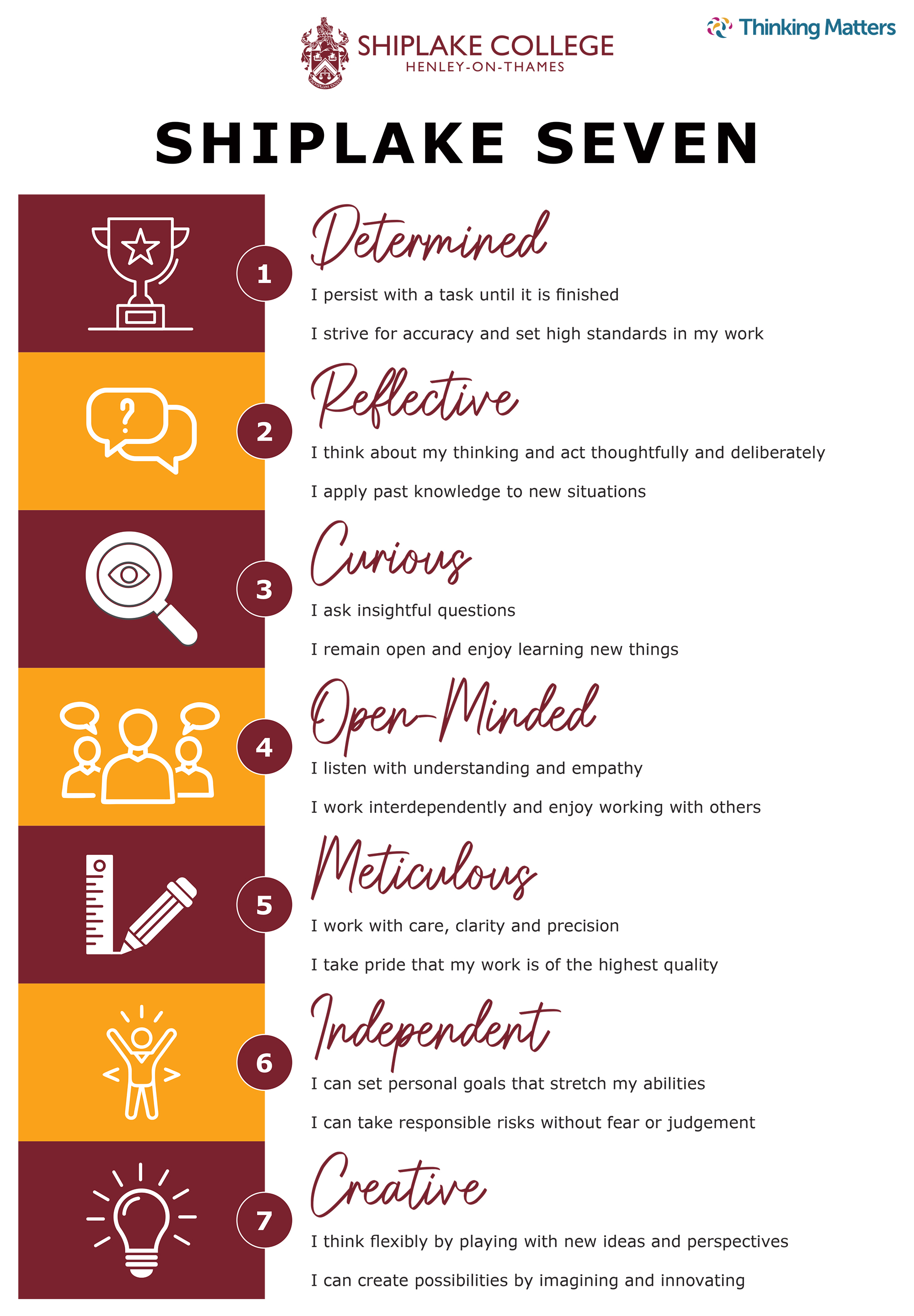
Shiplake Seven
The Shiplake Seven is a teaching and learning framework designed to foster and develop key interpersonal qualities in our young people. The seven qualities not only provide a solid foundation for pupils to achieve success throughout their education, but also equip our leavers with the skills they need to enter the next stage of their lives as confident, personable and talented young adults.
The framework is integrated across the academic and co-curriculum, allowing the seven qualities to be nurtured inside and outside the classroom. Pupils are encouraged to use these skills in their lessons and activities, with staff awarding 'excellence slips' in recognition of notable achievements or good behaviour. Staff meet regularly in cluster groups to share best practice and discuss how each of the qualities can be implemented into teaching and learning.
The Shiplake Seven framework provides fresh energy and direction to our already excellent teaching and learning. The qualities were selected by a panel of teaching staff from a larger pool of attributes put forward by pupils. We firmly believe that these qualities are essential for pupils to achieve success at school and subsequently in their chosen careers. Whilst, of course, these skills were already being developed by teaching across the curriculum, this framework will allow pupils' personal development to be more comprehensively encouraged, monitored and rewarded.
Learning Research Group
The Shiplake College Learning Research Group is a collaborative team of teachers engaged in practitioner research within their own classrooms. Their aim is to investigate which elements of pedagogy are most effective in the specific context of Shiplake, using evidence from real teaching and learning experiences. Through this ongoing process of inquiry, reflection, and analysis, the group continually refines both their teaching approaches and the broader curriculum priorities across the College, and publishes a Shiplake Learning Journal, summarising the findings of the group. This commitment to professional learning ensures that Shiplake’s educational practices remain dynamic, responsive, and tailored to the needs of its pupils. Copies of our inhouse journal, published at the end of each cycle, can be found here.