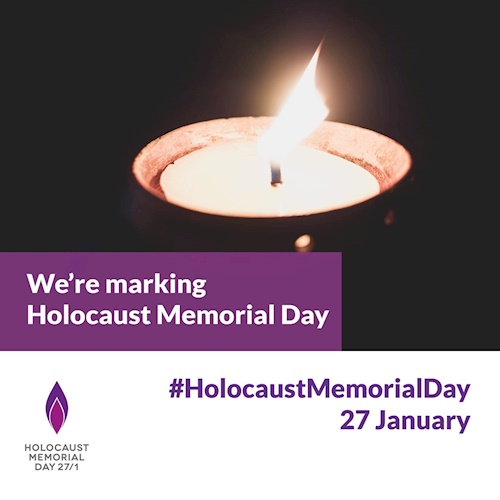
Holocaust Memorial Day, marked each year on 27 January, is when we remember the six million Jewish people who were persecuted and murdered by the Nazis and their collaborators during the Second World War. It is also a day to honour the memory of other groups targeted by Nazi persecution, including Roma and Sinti people, disabled people, gay people, Jehovah’s Witnesses, political opponents, and many others.
The theme of this year’s Holocaust Memorial Day is ‘Bridging Generations’, a powerful reminder that the responsibility of remembrance does not end with the survivors. It is carried forward by their children and grandchildren, and by all of us. More than 80 years after the end of the Second World War, the horrors of the Holocaust remain widely documented and deeply remembered, ensuring that the stories of those who suffered and were murdered are not forgotten.
In yesterday’s Whole School Assembly, the Shiplake Community learned more about the significance of Holocaust Memorial Day through a presentation led by Mr Ben Cartwright, Teacher of Theology and Philosophy.
He reflected:
“Some of you may know that I have had the privilege of travelling across Europe to learn about one of the most important and darkest episodes in human history: the Holocaust. Whenever I visit places connected to this history – whether in Poland, Lithuania, the Czech Republic, or elsewhere – I am always struck by what I call the “presence of absence.”
The light of the candle draws our attention to the emptiness around it. In the same way, learning about the Holocaust is not only about remembering the persecutions, concentration camps, or gas chambers. It is also about remembering the world that existed before: the lives, communities, culture, and everyday humanity that were destroyed. It is about remembering not just what happened, but what was lost, and what could have been.
This matters more than ever today because many Holocaust survivors have now passed away. As their voices become fewer, the responsibility to remember increasingly falls to the next generations. In 1905, the Spanish philosopher George Santayana wrote, “Those who cannot remember the past are doomed to repeat it.” That is why the 2026 Holocaust Memorial Day theme, “Bridging Generations,” is so important. Memory does not end with those who experienced events themselves; it continues through those who choose to listen, learn, and pass those stories on.
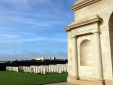
When we speak about the Holocaust, we are referring to the systematic, state-sponsored persecution and murder of approximately six million European Jews by the Nazi regime and its collaborators between 1933 and 1945. The Holocaust was not inevitable, but began with ideas rooted in prejudice and hatred, which were allowed to grow into discrimination, humiliation, and exclusion. From there came violence, ghettos, and the deliberate mass murder of Jews and other groups in camps such as Auschwitz, pictured here in the modern day.
While Jews across Europe were the victims of a terrible crime, we must be careful not to see them only as victims. To do so risks stripping them of their humanity. They were individuals with families, jobs, talents, hopes, and futures. To help illustrate this lost world, and to highlight the presence of absence, I want to take you briefly to the city of Lublin, in south-eastern Poland.
In July 2024, I spent seven days in Lublin with the Holocaust Educational Trust, learning about the city’s Jewish history through the work of the Grodzka Gate museum and theatre. The Grodzka Gate itself once marked the boundary between the Christian part of the city and the Jewish quarter
The Jews of Lublin, who lived outside the Grodzka gate for centuries, built a rich and vibrant culture. The first Hebrew books in the city were printed in 1578, and the Council of Four Lands, a central body of Jewish self-government in Poland, met in Lublin until the 17th century. Because of this, Lublin became known as the “Jewish Oxford” and the “Jerusalem of the Polish Kingdom.” Today, only a fraction of what the Jewish community had contributed to Lublin remains. The Lublin Yeshiva (or Torah school), built in 1930, was built at the height of Jewish culture and learning in the city’s history. Work is ongoing to rebuild a library here that is close to the size that the Nazis burned when they invaded.
In addition, as you look at the Grodzka gate from what was the Jewish quarter. Before the Second World War, this was the side of many houses for Jewish families going back centuries. These were damaged beyond repair during the war. After taking the city from the Nazis, the Soviets decided to flatten the area and build a parade square. Today, it is a car park, and a stark reminder of the presence of absence that is so clear in Lublin.
When the Nazis occupied Lublin in September 1939, any hope that life might improve for the city’s Jews disappeared. In March 1941, Jews were expelled from their homes and forced into a ghetto on the edge of the city, pictured here, where they lived in overcrowded and desperate conditions, uncertain of their fate. Before the war, around 45,000 Jews lived in Lublin – over a third of the population. Almost all of them were murdered during the Holocaust.
Today, the Grodzka Gate museum exists to preserve and share the history of Lublin and its people. I had the priviledge of investigating its powerful audio archive of Holocaust survivor testimonies, with people describing their lives, memories, and experiences. The theatre hosts performances created by local residents, bringing fragments of the past into the present.
For me, the most striking part of the museum was the records archive. It contains files for the Jews who once lived in Lublin. Many of these folders are almost empty – perhaps just a name or a photograph. Each file represents a person, a life, and a future that was taken away. Standing there, I felt the presence of absence more strongly than anywhere else. Yet the archive is also a sign of hope: proof that the people of Lublin today still remember those who once walked the same streets.
The Grodzka Gate is a powerful example of what it means to bridge generations. People from different backgrounds work together to preserve memory and ensure that absence is not forgotten. Next week, you will hear Lizzie speak about her own personal connection to the Holocaust, another way these bridges are built.
As you go into your week, I invite you to reflect on where you notice the presence of absence in the world around you. Where do you see things that are not as they should be? And how might you, in your own way, help to remember, challenge injustice, and make the world a better place?”