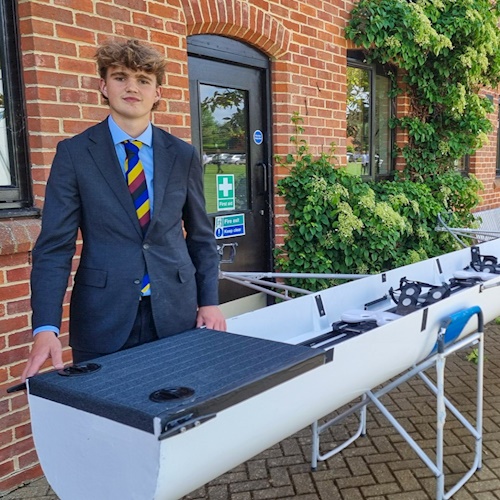
Sixth Former Finn Willis has been putting his passion for rowing into practice through an ambitious and highly practical Extended Project Qualification (EPQ), designing and building a unique rowing simulation training boat for Shiplake College Boat Club.
Finn’s project, titled “The design and modification of an 8-person rowing shell using composite materials to create a device that will allow a 25m swimming pool to be used as a rowing tank”, aims to enhance winter training opportunities and provide a safe, accessible way to teach rowing technique.
Inspired by his own interest in rowing and engineering, Finn chose the project to explore how equipment design can influence performance and technique. “I wanted to combine my interest in rowing with something practical and hands-on,” he explains. “I’ve always been curious about how equipment design affects technique, so building a training boat felt like the perfect way to explore that.”
The project involved extensive research into hull shapes, rowing physics, and shell construction. Using this knowledge, Finn developed his own design before sourcing an old eight-person shell, which he discovered under Chiswick Bridge in London. After transporting it to his workshop, he began the process of repair and transformation.
The build itself was both technically challenging and highly innovative. Finn cut the shell to create a smaller, four-person training vessel, installing laminated fibreglass and closed-cell foam bulkheads to seal the ends. As the boat is designed to remain fixed within a swimming pool or enclosed body of water, traditional bow and stern sections were not required. He then completed the project with a high-gloss enamel paint finish and carried out on-water testing, making further refinements to the rigging based on performance.
The result is a training boat specifically designed to replicate the feel of rowing on the river, while offering increased stability and control. This makes it particularly valuable during periods when river conditions are unsafe, such as flooding, or during the winter months when access can be limited.
“The boat’s sole purpose is to accurately replicate the feeling of rowing without being on the river,” says Finn. “It helps with balance and technique by being slightly more stable than a normal rowing boat. This encourages rowers to engage their core and maintain good posture throughout the stroke.”
In addition to supporting individual development, the boat also provides a useful platform for coaching. With rowers positioned in a controlled environment, coaches can more easily observe technique and offer immediate feedback, making it an effective alternative to more traditional training methods.
Finn believes the project will benefit a wide range of athletes at the College. “Beginners will be able to build confidence in a safe and controlled setting, while more experienced rowers can use it to fine-tune their technique when they can’t get out on the water.”
Reflecting on his EPQ experience, Finn encourages other students to be bold in their project choices. “Dream big and don’t let anyone tell you your idea is too ambitious – if you can imagine it, it’s possible. Choose something you genuinely care about, as it makes the whole process more enjoyable. Planning early, staying organised, and being open to adapting your project are also really important.”
Finn’s innovative approach and dedication to his project are an excellent example of the creativity and ambition encouraged through the EPQ programme at Shiplake College. We look forward to seeing how this project is utilised in future.


.jpg/ShiplakeAchievesTop10%inBebras(1)__500x500.jpg&command_2=resize&height_2=85 "Shiplake Achieves Top 10% in Bebras")