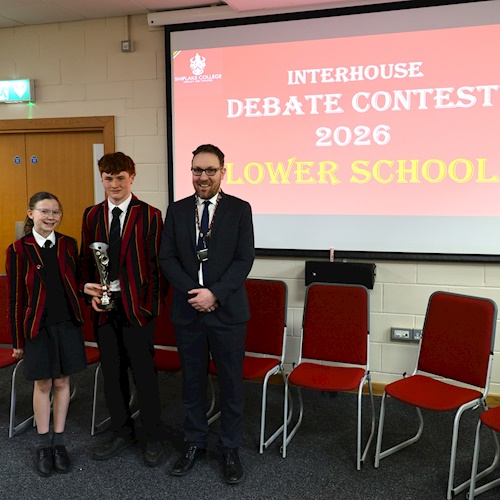
On Tuesday 10 March, the Lecture Theatre played host to the Lower School Inter House Debate Competition, a lunchtime that brought together pupils from Burr, Everett, Orchard, Skipwith and Welsh for a lively display of clear thinking, confident speaking, and collaborative discussion.
Following the well‑established Shiplake debating format, each pair opened with 60‑second arguments for or against their assigned motion before the floor opened to wider contributions. What followed was an engaging sequence of exchanges, with pupils questioning ideas, testing assumptions, and challenging one another with maturity beyond their years.
Debate One: Homework doesn’t help and should be banned
The first motion sparked an enthusiastic mix of personal experience, moral questioning and surprising historical claims.
Those arguing for banning homework highlighted the pressure it places on young people, referencing studies suggesting it can increase stress and reduce time for creativity, hobbies and family life. Several speakers argued that teachers should teach all necessary content in lessons, questioning the very purpose of additional work at home. Others emphasised that homework limits outdoor activity, social interaction and important time with family.
The opposing side countered with the view that homework strengthens understanding, deepens subject knowledge and helps pupils challenge themselves beyond the classroom. They argued that independent study is an important part of academic growth.
During the open floor discussion, pupils debated whether homework encourages rushed and unfocused work, and whether self‑study at home is genuinely effective. One particularly memorable contribution included the surprising claim that homework was invented in the 1800s by “nonviolent teachers” seeking new ways to discipline students—an idea that prompted thoughtful reactions across the room.
Debate Two: Climate change is the biggest threat to our planet right now
The second motion widened the conversation to global issues, with pupils examining both immediate dangers and long‑term consequences.
Those arguing against the motion suggested that war, illness and financial instability pose more urgent threats. Speakers cited current geopolitical tensions—including conflicts and unstable leadership—as dangers that could escalate rapidly with potentially devastating consequences.
The pro‑motion side countered that climate change is already reshaping our world, influencing food and water security, animal health, and the future facing young people today. They emphasised that climate change affects everyone and that the choices made now will shape generations to come.
The open discussion brought forward nuanced reflections: while wars cause immense loss of life, some argued they can be stopped—whereas climate change cannot simply be ‘paused’ or reversed. Others suggested that climate change may even trigger future wars and further global instability. Speakers disagreed on which danger is more immediate, but all acknowledged the seriousness of each issue.
Final Standings:
Winners: Orchard — Jamie Pattinson Smith & Grace Perkins
Runners‑Up: Skipwith — Blake Rickerby & Leafy Schillebeeckx
Burr: Kitty Martin & Ali Curran
Everett: Rafferty Willis & Murray Hall
Welsh: Eva Merry & Evie Chester
The afternoon showcased not only the debating potential of the Lower School, but also their ability to listen, respond and think critically about the world around them. Congratulations to all involved—and especially to Orchard for their win.