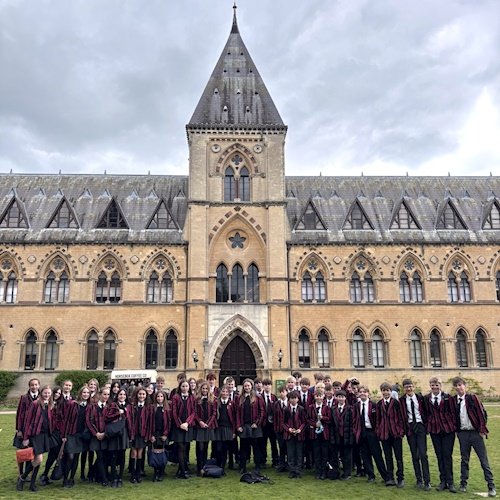
On Tuesday 12 May, Year 8 pupils enjoyed an enriching trip to Oxford, where they had the opportunity to explore two of the city’s most fascinating museums.
The pupils were split into two groups, each beginning their visit at a different location. One group headed to the Oxford University Museum of Natural History, where they discovered how fossils can reveal the story of the Earth’s past, from ancient dinosaur remains to more recently extinct animals. The visit provided insights into the evolution of life, while additional exhibits on insects, precious metals and even sea creatures that once inhabited Oxfordshire captured pupils’ imaginations and highlighted the region’s unique geological history.
Meanwhile, the second group visited the History of Science Museum, where they explored centuries-old measuring instruments and learned about the development of scientific understanding over time. A particular highlight was discovering how Islamic scholars used astrolabes to predict the time, track constellations and calculate sunrise and sunset. Pupils even had the opportunity to try using one themselves, merging science and history with hands-on learning.
Following lunch, the groups swapped over, ensuring that all pupils experienced both museums. By the end of the day, they returned to school full of new knowledge and enthusiasm, having engaged directly with the scientific ideas they study in the classroom.
Miss Magarinos Rodriguez, Physics Teacher, commented: “Visits to institutions such as the Natural History Museum and the History of Science Museum enrich students’ learning by providing real encounters with scientific artefacts, fostering curiosity, and deepening their understanding of how science develops over time.”
Trips such as this play an important role in supporting pupils’ education beyond the classroom. By encountering real-world examples and engaging directly with historical and scientific artefacts, pupils deepen their understanding, strengthen their curiosity and develop a greater appreciation for the subjects they study. Experiences like this also encourage independent thinking and help bring academic concepts to life, making learning both memorable and meaningful.